The recent viral icy road video in circulation of a camera-equipped car involved in a multi-vehicle pileup in West Virginia provides an opportunity to bring up a couple of points of discussion about a few common myths and misconceptions.
The road conditions in progress illustrated snow icing, not "black ice". This may seem slightly nitpicky, but the icing in this video was not 'black ice', but rather pure snow. 'Black ice' is the visually stealthy phenomenon created by freezing rain, freezing drizzle and freezing fog. See Types of road icing and causes and a picture of what actual "black ice" looks like.
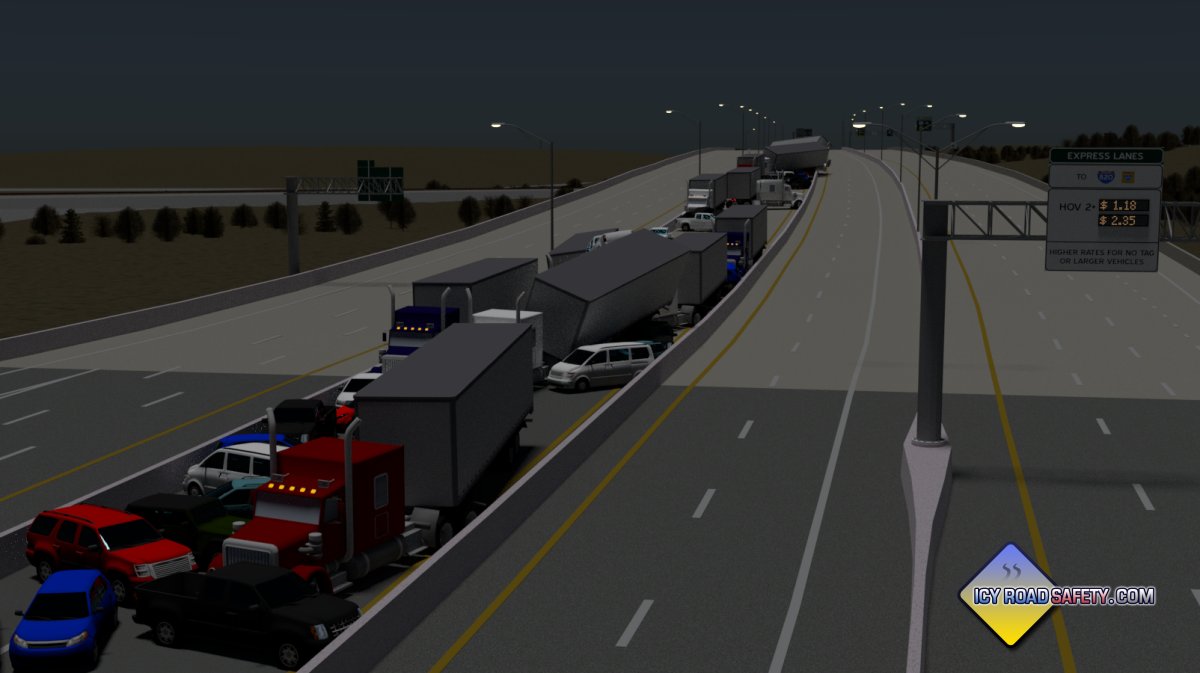
MYTH: Driver skill can prevent ice-related accidents at high speed. TRUTH: Avoidance of high-speed icy road collisions is usually more related to luck/chance and less about driver skill. Comments on the video largely praise the camera car's driver (Mitsubishi Evo) for his skill in avoiding a collision while disparaging the driver of the neighboring vehicle (Ford Flex) for colliding with the minivan. The reality is that the chance positioning of the stopped vehicles, and the lane the moving vehicles were in, was the sole determining factor of the outcome. Both vehicles (and the 18-wheeler) equally were traveling too fast to safely avoid the accident - the camera vehicle (Evo) was able to avoid a collision simply because it was in the left-hand lane, and only *by chance* had a clear path to avoid the stopped vehicles ahead. If any of the stopped vehicles were resting a few feet to the left, the Evo would have not been able to avoid colliding with them. The Flex simply had nowhere to go and could not have possibly avoided a collision, skill/technique or lack thereof, had no role in the outcome.
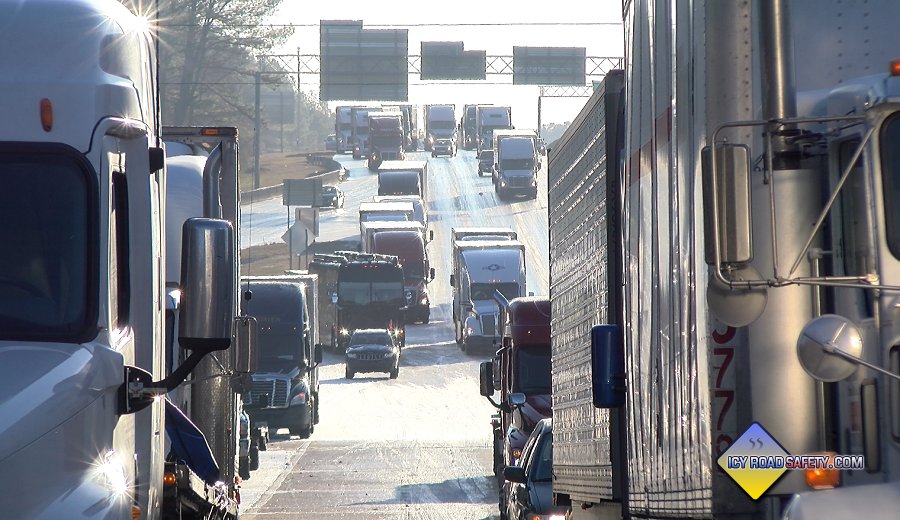
Both vehicles were traveling too fast for the conditions. While evidence indicates that the intermittent snow squalls in progress at the time would have resulted in a rapid transition from clear roads to snow-covered roads, this transition zone would still have been just gradual enough for vehicles to see it coming and react. It is obvious from the video that many vehicles did not slow down upon encountering the first signs of snow on the road, continuing on at highway speeds despite the worsening conditions (the engine on the camera vehicle can be heard throttling down only after the accident ahead is visible, by then too late). The reasons for this widespread behavior are probably deeply rooted in the current public perception of the road ice hazard as merely a nusiance, and not the real threat to life and property it truly is. Drivers feel that their vehicle can continue on at highway speeds as a result of tires, antilock brakes, traction control or stability control. In reality, none of these technologies allow for safe highway speed travel on icy roads. See the article No vehicle can safely go highway speeds on icy roads.
Monday, January 2 saw an exceptionally widespread, damaging and tragic road icing event/accident outbreak across multiple states, caused by a minor snowfall event. Numerous major pileups occured on interstates and highways with several fatalities and countless injuries in Ohio, Kentucky, West Virginia, New York, Indiana, Illinois, Virginia and Michigan. This event is one of the largest/worst in the US that I have come across during the past three years, and will warrant some data collection and a in-depth write-up after the full impact can be assessed. I will begin work tomorrow collecting information and data on this event, followed by an eventual case study to be posted here at a later date.
Preliminary notes: It appears at this time that the snowfall amounts associated with the worst accident numbers were very low, many cases an inch or less. Areas that saw higher accumulations generally experienced fewer accidents. This is consistent with previous data which shows that lighter snow events cause more severe accident outbreaks than bigger snowstorms. An intermittent 'squall' pattern of the precipitation also appears to be a major factor in the severity of this event. Much of the snow fell in intense, narrow bands, resulting in patchy, treacherous icing that drivers encountered suddenly.
Here are just a few of the news reports that have come in so far today:
As of 11:55PM Monday night, the reported death toll for this outbreak is at 4. That number will likely rise as more reports come in in the next 2 to 3 days. Stay tuned for updates on this event as more information is collected.
Lessening the impact of icy roads on public safety is a three-fold process:
The NWS officially recognizing road icing as a high-impact, high-threat weather hazard and issuing strongly-worded warnings,
Effective communication of those warnings to the public, and
Educating the public on the hazard: the degree of threat and how to recognize and respond to the conditions.
We've discussed the first two of those points before, but I wanted to highlight what I believe is one of the major problems in the realm of item #3: the widespread belief that a modern vehicle's equipment or technology allows safe travel on icy roads at highway speeds.
The reality is that there is no technology, no tire nor any vehicle type that allows SAFE travel on any type of icy road (snow, sleet or freezing rain) at speeds greater than 45mph. Not traction control, electronic stability control, 4WD, AWD, antilock brakes or the most expensive brand-new snow tires. While all of those safety features will improve a vehicle's handling and control to some degree, they do not eliminate the danger of losing control at highway speeds over 45mph in any type of road icing condition.
Nearly all of the icy road accident fatalities I have documented have involved vehicles traveling at or above 45mph, with the vast majority occurring on interstates or rural two-lane highways. Many, if not most, of these vehicles were equipped with some or all of the modern-day safety equipment and features. I have personally witnessed, and captured on video (see it yourself), modern vehicles equipped with good tires, traction control, AWD and/or 4WD crashing on icy roads.
The general driving public has been poorly informed about this critical point. Most assume that icy road accidents are caused by either an inexperienced or reckless driver, or a vehicle with bad/worn tires. Advertisements for tires and vehicles with new safety technologies are misleading, showing cars speeding through snow with ease. This certainly is a contributing factor to road ice accident numbers, implicitly suggesting that the product allows a the driver to continue normally in icy conditions without a reduction in speed.
It all boils down to the laws of physics, specifically the coefficient of friction between rubber and ice. No tread pattern or computer program will change this fundamental law of nature. Driving above 45mph on icy roads is beyond the limitations of anything currently available to prevent a vehicle from fishtailing, oversteering, understeering or slowing/stopping on an incline.
Any time you drive above 45mph on icy roads, your vehicle enters a highly unstable state on the brink of loss of control. At that point, all that is needed is some type of trigger to set in motion a loss of control sequence that you will most likely not be able to recover. That trigger can be a slight steering motion, a lane change, a gust of wind from a passing truck, a tap of the brakes or a push of the accelerator. Even below 45mph, the loss of control potential exists (namely with black ice) - the difference is at lower speeds, the chance of you leaving the roadway is reduced, and if you do hit something, the impact is less likely to cause serious injuries.
The only SAFE way to travel on icy roads is to keep speeds below 45mph (or lower), regardless of any type of tire or safety technology your vehicle may have. A large number of road ice-related accidents can be prevented if drivers follow this simple guideline when they know the hazard exists or is imminent. Again, to that end, education and warnings remain an important goal.
One of the issues we commonly see each winter is that there are many sub-criteria events that don't prompt watches, warnings or advisories, yet have a high impact to the public in terms of deaths, injuries and property damage from road ice-triggered accidents. Light sub-criteria freezing rain can cause events such as the February 23, 2011 accident outbreak in St. Louis, a high-impact outbreak that occured completely without warning due to the precipitation amounts being below established criteria. Likewise, light snow can also cause such a high-casualty event like we saw across the Midwest region this past Thursday and Friday, which has claimed at least 5 lives and hundreds if not thousands of vehicle damage incidents across several states. Here are a few news articles:
Light snow creates icing that is deceptively innocuous-appearing, particularly in high-traffic areas where the white coating is compacted into 'black ice' in the center of the road. Furthermore, these events typically recieve little media coverage and consequent low public awareness levels. As a result, vehicles are typically traveling - and crashing - at much higher speeds during light snow events than they do during big snowstorms. Many of the mass-casualty icing events I have tracked in past years have been due to light amounts of either snow or freezing rain. Most of those were too light to trigger watches, warnings or advisories, and those that barely crossed that threshold only received a lightly-worded advisory.
The National Weather Service currently issues products directly concerned with road icing, but they have two main problems:
The products are not directly named for the hazard. Winter Weather Advisories, Freezing Rain Advisories, Freezing Fog Advisories and Snow Advisories are all products that are issued solely to cover the road ice hazard. The conditions prompting these products pose no other threats to the public than hazardous motor vehicle travel (and to a lesser extent a walking hazard). The more meteorologically-educated person will immedialy recognize each of these products and their implications with little thought, but the non-weather-saavy person usually will not. Re-titling these as "Road Ice Warning" or something similar would convey the hazard more plainly to the end users (public and media). If the importance of naming the precipitation type responsible remains a necessity, then possibly the ptype could be appended to the warning title "Road Ice Warning for snow"; "Road Ice Warning for freezing rain". Removing the need for the end user to make a mental connection between the name of the advisory and its hazard would certainly improve the overall communication of what the real danger is.
It's true that the supporting text of these advisories mentions hazardous travel, but it is unusual for members of the general public to hear or read this additional text. The title of the product is the most important, as it usually receives widespread broadcast via television, radio, digital highway signs, social media, text message, email alerts, web sites and more.
The precipitation amount criteria for these products is too high. Compounding the problem of the current suite of products is that while they are solely concerned with road icing, they are often not issued for light sub-criteria events that have the same public impact as advisory-critera events. This is evident in the many such events we see each winter, such as 2/23/11 in St. Louis and 12/8-9/11 from Nebraska to Indiana.
The cost and manpower needed to make these simple changes will be minimal if not non-existent. Here's why:
High-impact icing events occur infrequently. Lowering the precipitation amount criteria will result in more "Road Ice Warnings" being issued than the current suite of advisories see, but only by a factor of two or possibly three in most areas of the US. Not nearly enough to begin to place an undue burden on the system and personnel, nor enough to create a 'crying wolf' syndrome. The highest icing-related death rates occur in a belt traversing the Midwestern USA, places in which roads are normally ice-free except for a dozen or so discrete events each winter. Currently only a half or so of those trigger advisories or warnings, yet all have the same level of public impact potential.
High-impact icing events are easy to detect in advance. While many light icing events are not evident in models more than 12 hours out, when they are imminent (less than an hour or two away), they are easy to spot. Most of the time these involve rain showers or snow bands moving toward (or developing over) ASOS/AWOS stations reporting below-freezing temperatures - nearly all of which are evident early enough to get warnings out to the public. Most NWS forecasters are already keenly aware of the potential for such events, but lack the authority and protocol to "sound an alarm" via a strongly-worded, universally-understood warning once it appears likely to happen. This has been the case with many events we've seen each winter.
Will a "Road Ice Warning" solve the problem and prevent all accidents and resultant deaths and injuries? Of course not. Tornado warnings don't prevent all tornado deaths, yet they have proven indispensable and effective for the members of the public who will follow them. Likewise, there's no reason to expect that a similarly-aware member of the public wouldn't take heed to a warning for road ice. The low cost and simplicity of implementing a Road Ice Warning product, combined with its potential for saving lives, makes it a priority that I hope our officials will strongly consider soon.
As with any public awareness cause, progress only results from a team effort. And so, as we head into the heart of road ice season in the USA, this post is to give a big thank you to all of the supporters of the cause and those who have linked to this site. The road ice safety issue has benefitted greatly from these individuals, businesses, organizations, media outlets and government entities, all who have made a difference by helping this site spread the message.
Right on schedule, the grim weather hazard of road ice is already taking hold this season. The past week has brought the season's first snowfall to many parts of the country, and with it, the first multiple-fatality and injury accident reports. The toll from road ice this week has reached at least 15, with news feeds lighting up with reports of multiple fatal crashes in numerous states. The following is a list of this past week's incidents so far, and more reports will likely come in over the next few days. Many of these have resulted from an early-season snow event in the northeastern US states.
Road icing deaths: October 27 - November 3, 2011
Location
Fatalities
Notes
Ridley, PA
1
Windsor, NY
1
secondary crash
Babylon Village, NY
1
secondary crash
Stroudsburg, PA
1
Hebron, CT
1
Hartford, CT
1
rollover, no seatbelt
Bristol Township, PA
1
rollover
Philadelphia, PA
2
part of 30-car pileup
New York, NY
2
secondary crash
Binghamton, NY
1
bridge, secondary crash
Northampton, MA
2
rollover
Tucumcari, NM
1
rollover, no seatbelt
Five of these fatalities involved the secondary or 'follow-up' crash phenomenon, where motorists (either Good Samaritans or accident victims) were struck by a subsequent out-of-control vehicle after standing outside on the roadway. The victims were outside either checking on another driver or inspecting the damage to their own car. These are five more tragic examples of how the first icy road accident scene is still actually an accident-in-progress situation, and as such, it is critical to everyone involved to either remain in their vehicles or get as far off of the roadway as possible, as quickly as possible. Further out-of-control cars and trucks are almost certain to be approaching, with no way to avoid a collision with someone standing on or along the road. If stranded motorists are unable to get away from the road (as in the middle of a bridge), a car's interior provides a more survivable collision protection than standing outside.
As a result of research of events during the past few winter seasons, I've noted that injury and total accident numbers can be very loosely estimated from the number of deaths. During a typical event, for every death recorded, there are 50 to 150 injuries; and anywhere from 400 to 1,000 accidents serious enough to be reported to police. I prefer to be conservative when estimating numbers to avoid any appearance of exaggeration, so I usually use the lowest possible multiplier: That yields formulas of Injuries=50x deaths and Accidents=400x deaths. So without painstakingly counting every single injury and damage-causing accident using police reports, we can roughly estimate from this ratio that at least 750 injuries occurred this week, with at least 6,000 vehicles damaged. Again, those are minimum numbers using a conservative estimate - they are likely much higher in actuality. Assuming an average damage loss to a vehicle of $8,000 (some cars totaled, others dented/scratched), the economic loss from vehicle damage alone for this week is likely more than $48 million. That does not include medical expenses for the injured, tow truck fees, police/fire/EMS overtime/operating costs, and lost work time/productivity from those injured or having a damaged car to deal with.
15 deaths. 750+ people hurt. $48+ million in damage. And it's only November 4, folks. That's the road ice hazard, and that's why this web site exists. We have a long winter ahead. Let's see what we can do to make a difference this season.
Your work needs to be recognised internationally as an authority which is thinking about prevention - Posted by richard starling dad of an ice-caused paraplegic from devon, uk
Thank you Richard, I appreciate your support. - Posted by Dan R. from New Baden, IL
Saturday, October 22, 2011 - 1:28AM
2011-2012 road ice season in the US already in full swing
While mid to late September can bring the first few road ice crashes in the US, October is typically the month when the first major accident outbreaks begin to occur. As with many of the past few years, it is Colorado's Front Range that has seen the season's biggest event so far, one that included a tour bus crash, and unfortunately, the season's first known road ice fatality. Montana has also reported an injury accident event this month.
The threat is coming for the rest of the country in short order. November typically sees road ice fatality rates into the double digits. The following are two links to news reports from this month's events:
During the middle of one of the worst heat waves in recent years seems like a strange time to bring up the subject of road icing safety awareness. But in just two months, temperatures in the US will begin their annual decline, bringing the first icy roads to the highest mountain elevations by mid to late September.
We've seen how data shows that in the average year, icy roads kill and injure more people in the USA than ALL other weather hazards combined. But every so often, another weather danger will take center stage with an anomalously high casualty toll and human impact.
In 2005, it was a historically devastating hurricane season that overwhelmed other hazards in terms of deaths, injuries, property damage and human suffering - the majority of which, of course, came from Hurricane Katrina. Much like hurricanes did in 2005, tornadoes have done it in 2011. This year's astonishing number of violent tornado events in populated areas has resulted in four almost unheard of statistics:
one of the highest annual tornado death tolls in recent history
one of the single most deadly tornadoes in history (the Joplin, Missouri EF5)
one of the highest death tolls during a single outbreak of tornadoes (the April 27 southern outbreak)
a remarkably high number of cities/major metro areas directly hit by tornadoes (St. Louis; Minneapolis; Springfield, MA; Raleigh, NC; Tuscaloosa and Birmingham, AL; Louisville, KY; Joplin, MO; )
2011's big weather story, rightfully so, will be its tornado season. But a fact that will likely go unnoticed is that after winter is done, road icing will have claimed the same number of lives as this year's devastating tornadoes.
But it doesn't have to be that way. Let's work to change that this winter! Some ways you can help:
Remember that it is the light icing and snow events that are most deadly. Big ice storms and snowstorms already benefit from high public awareness and tend to have very few incidents. It's the more subtle events that cause the most accidents, deaths and injuries.
Media professionals, you can help raise awareness by emphasizing the icing hazard when it occurs in your broadcast area - and give it the same urgency you would a tornado warning.
National Weather Service, consider dedicating resources and facilitating operational changes to warn the public about the high danger from light icing and snow events.
Storm chasers and spotters, consider covering light ice and snow events this winter to increase awareness of the hazard in your local area, and report dangerous icing conditions to the NWS just as you would a tornado or large hail.
State highway departments, coordinate with the NWS during light ice and snow events and utilize resources to help warn drivers (electronic signs, email and text notifications, etc).
and finally, and most importantly: Drivers - realize the level of danger from road icing, know the warning signs, and take action accordingly (by either postponing travel or simply slowing down). Read icyroadsafety.com for tips and information.
Together, we can keep this upcoming winter's icy roads from surpassing the 2011 tornado season in lives lost.